
Ab jetzt sind wir Elev8
Wir sind mehr als nur ein Broker. Wir sind ein All-in-One-Trading-Ökosystem – alles, was Sie zum analisieren, traden und wachsen brauchen, ist an einem Ort. Sind sie bereit, Ihr Trading zu verbessern?
Wir sind mehr als nur ein Broker. Wir sind ein All-in-One-Trading-Ökosystem – alles, was Sie zum analisieren, traden und wachsen brauchen, ist an einem Ort. Sind sie bereit, Ihr Trading zu verbessern?
The Australian Dollar (AUD) extends its gains for the second successive session against the US Dollar (USD) on Thursday. The AUD/USD pair remains stronger following the release of domestic trade balance and China’s Caixin Services Purchasing Managers’ Index (PMI) data.
Australia’s trade surplus fell to 5,413M month-over-month in April, came below the 6,100M expected and 6,892M (revised from 6,900M) in the previous reading. Exports declined by 2.4% MoM in April, against a 7.2% rise prior (revised from 7.6%). Meanwhile, Imports rose by 1.1%, compared to a decline of 2.4% (revised from -2.2%) seen in March. China’s Caixin Services PMI rose to 51.1 in May as expected, from 50.7 in April.
The AUD/USD pair also gained ground as the US Dollar continues to face challenges following the weaker economic data and rising economic uncertainty in the United States (US). Traders will likely observe the US Balance of Trade and the weekly Initial Jobless Claims later in the North American session.
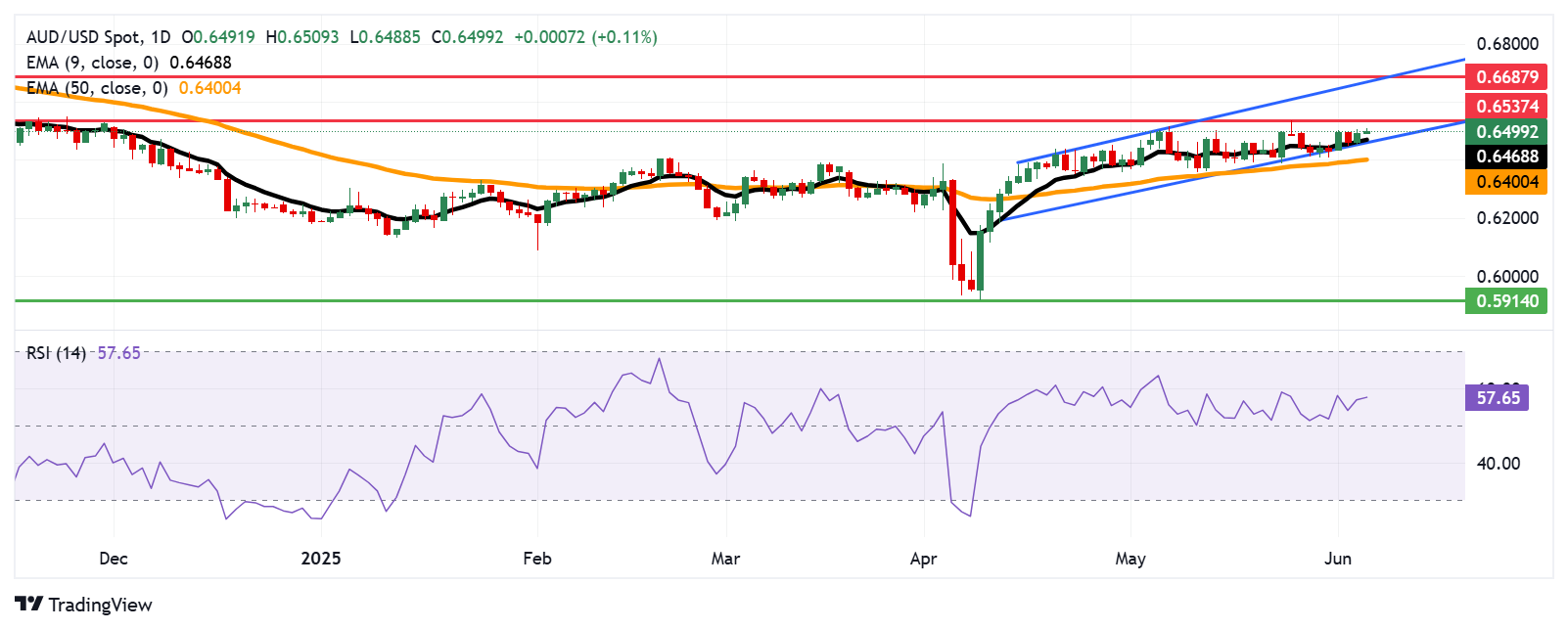
The AUD/USD pair is trading around 0.6500 on Thursday, with a persistent bullish bias. The daily chart’s technical analysis indicates that the pair remains within the ascending channel pattern. The short-term price momentum remains stronger as the pair stays above the nine-day Exponential Moving Average (EMA). Additionally, the 14-day Relative Strength Index (RSI) is positioned above the 50 mark, suggesting a bullish outlook.
On the upside, the AUD/USD pair may target a seven-month high of 0.6537, which was recorded on May 26. Further advances explore the region around the upper boundary of the ascending channel around 0.6670.
The primary support appears at the nine-day EMA of 0.6468, aligned with the ascending channel’s lower boundary around 0.6460. A break below this crucial support zone could dampen the bullish bias and lead the AUD/USD pair to test the 50-day EMA at 0.6400.
The table below shows the percentage change of Australian Dollar (AUD) against listed major currencies today. Australian Dollar was the strongest against the Japanese Yen.
| USD | EUR | GBP | JPY | CAD | AUD | NZD | CHF | |
|---|---|---|---|---|---|---|---|---|
| USD | 0.04% | 0.07% | 0.11% | 0.03% | -0.10% | -0.01% | 0.04% | |
| EUR | -0.04% | 0.08% | 0.08% | 0.02% | -0.13% | -0.14% | 0.03% | |
| GBP | -0.07% | -0.08% | 0.04% | -0.06% | -0.20% | -0.20% | -0.07% | |
| JPY | -0.11% | -0.08% | -0.04% | -0.09% | -0.26% | -0.22% | -0.08% | |
| CAD | -0.03% | -0.02% | 0.06% | 0.09% | -0.17% | -0.14% | -0.00% | |
| AUD | 0.10% | 0.13% | 0.20% | 0.26% | 0.17% | -0.01% | 0.15% | |
| NZD | 0.01% | 0.14% | 0.20% | 0.22% | 0.14% | 0.00% | 0.16% | |
| CHF | -0.04% | -0.03% | 0.07% | 0.08% | 0.00% | -0.15% | -0.16% |
The heat map shows percentage changes of major currencies against each other. The base currency is picked from the left column, while the quote currency is picked from the top row. For example, if you pick the Australian Dollar from the left column and move along the horizontal line to the US Dollar, the percentage change displayed in the box will represent AUD (base)/USD (quote).
The trade balance released by the Australian Bureau of Statistics is the difference in the value of its imports and exports of Australian goods. Export data can give an important reflection of Australian growth, while imports provide an indication of domestic demand. Trade Balance gives an early indication of the net export performance. If a steady demand in exchange for Australian exports is seen, that would turn into a positive growth in the trade balance, and that should be positive for the AUD.
Read more.Last release: Thu Jun 05, 2025 01:30
Frequency: Monthly
Actual: 5,413M
Consensus: 6,100M
Previous: 6,900M
Source: Australian Bureau of Statistics